A structured execution infrastructure that improves delivery predictability, reduces coordination overhead, and aligns execution across scaling product organizations



Used by teams who want faster execution, fewer delays, and consistent outcomes


They have an execution problem. Work slows down not because of lack of the capability in the team but because the system behind it is broken
Invisible operational friction
Execution slows down through repeated clarifications, fragmented ownership and cross-team dependencies that accumulate across workflows over time
Limited executive visibility
Leadership often lacks clear visibility into operational bottlenecks, execution risks, workflow capacity and where delivery inefficiencies are actually created
Scaling coordination overhead
During the scaling, teams spend increasing amounts of time to managing work, resolving ambiguity and coordinating dependencies instead of executing efficiently
of delivery effort is consumed by rework and workflow inefficiencies
Operational inefficiencies rarely remain isolated. As organizations scale, repeated execution gaps compound across workflows, increasing operational waste, slowing delivery, and reducing organizational throughput over time
The system introduces structured operational standards that improve execution visibility, reduce workflow fragmentation, and create more predictable delivery across growing organizations
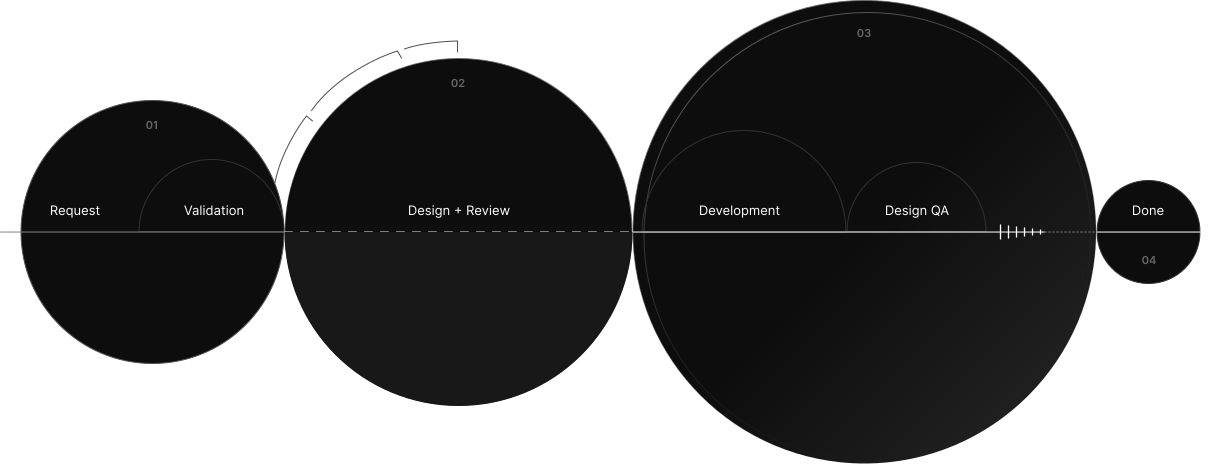
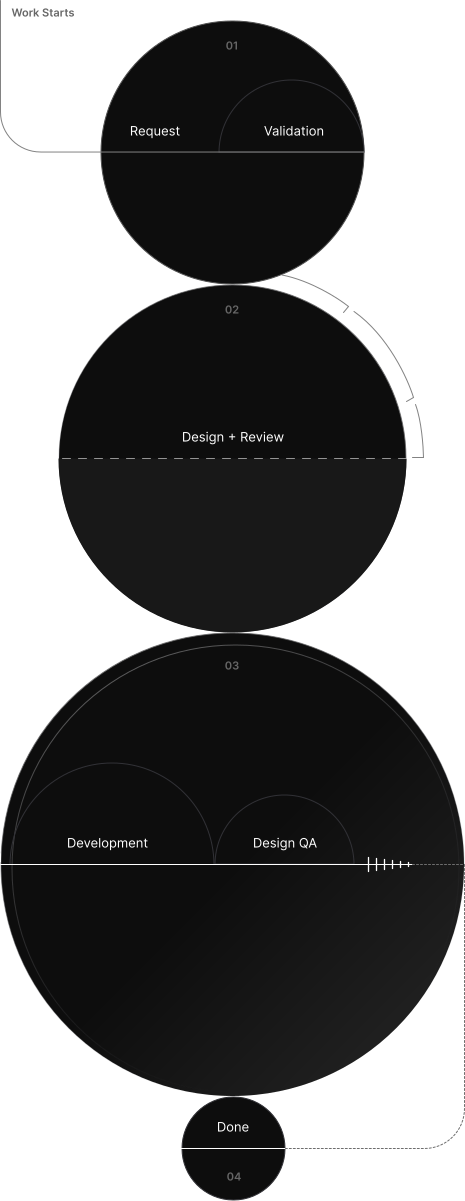
The execution infrastructure improves delivery predictability, reduces operational friction and creates scalable environments across growing organizations

Partners:


Total cost of ownership:
14%

Time-to-market:
27%

Reduced inefficiency on:
29%
Team size:
+60 employees

Partners:


Revenue growth:
$23M+
Time-to-market:
4 weeks → 3 days
Reduced costs:
46%
Team size:
+250 employees

Audit & Alignment
We analyze current flows across your team, identify operational inefficiencies and execution gaps

Implementation
The system is applied to real tasks, aligning in real time designers, developers, and product managers
Autonomy
Team operates independently within the system, with clear processes and predictable execution
Audit & Alignment
We analyze current flows across your team, identify operational inefficiencies and execution gaps
Implementation
The system is applied to real tasks, aligning in real time designers, developers, and product managers
Autonomy
Team operates independently within the system, with clear processes and predictable execution

Teams usually see measurable improvements in speed, reduced rework and decreased costs within the first weeks
Operational Execution Assessment
Measure where delivery effort is lost and what it costs annually
fixed fee
It includes:
• Operational workflow analysis
• Anonymous survey across the team
• Structured interviews across leadership
• Report with the annual cost of current friction
Execution System Implementation
Install the system in live work and directly hand it over to your team
of identified friction or $30 000
It includes:
• Setting up operational structure
• Cross-team execution alignment
• Live workflow correction on your real tasks
• 15 operational standards adapted to your roles

Proceed within 90 days and the $10 000 comes off the implementation fee. You never pay for the measurement twice
Team operates independently within the system, with clear processes and predictable execution
Team operates independently within the system, with clear processes and predictable execution
Why is the price based on our problem rather than your time?
Because you are buying a result, not weeks of my presence. A consultant priced by the day costs the same whether the system holds or not. This way the fee stays proportional to what the problem is actually costing you and you see the arithmetic before you commit to anything
Can we skip the assessment and go straight to implementation?
You can, but then implementation starts at $40,000 rather than $30,000, because the measurement still has to happen. It just moves inside the project. It is cheaper to run it first, and you keep the report either way
Is this just documentation or real implementation?
Implementation. The system is introduced directly into your team through real calls, workflows, tasks, and communication. The goal is ensure sustainable adoption across teams
Do we need to change our tools (Figma, Jira, ClickUp)?
No. ClickUp is the recommended platform and the one the system is configured in fastest, but the lifecycle can be built in Jira, Linear or Asana. Historical data is not migrated the previous system is archived read-only, because carrying old records into a new structure imports the habits the new structure exists to replace
How long does implementation take?
1 week for the assessment. From 4 weeks for implementation on a single team, with an additional week for each further team in scope. Your team operates the system independently at the end of it
Will this slow down our team?
In the first weeks, it could - measurably. We add 1-2 steps to get rid of the massive friction the cost of which is much higher comparing to cost of the time of those 1-2 steps. Basically, friction is moved to early stages where the cost of catch it is less. We measure lead time against baseline at day 90, not at week 2 to see results
What if our team resists the process?
Operational resistance typically emerges when process overhead increases without visible execution improvements. The framework is introduced through real workflows and active delivery environments, allowing teams to experience operational benefits directly through daily execution
Do you work with small teams or only large companies?
The system works best for teams that already have multiple roles (design, dev, product)
What happens after implementation?
Your team continues working independently. The system remains as a foundation for how work is executed, without requiring ongoing involvement. Moreover, you will have 14 days of asynchronous support follow handover, answered within two business days
When will we start seeing results?
Most teams begin noticing improvements within the first weeks as clarity increases, rework decreases and delivery becomes faster
If your team is growing but your process isn’t - it’s time to introduce structure
Book a Call